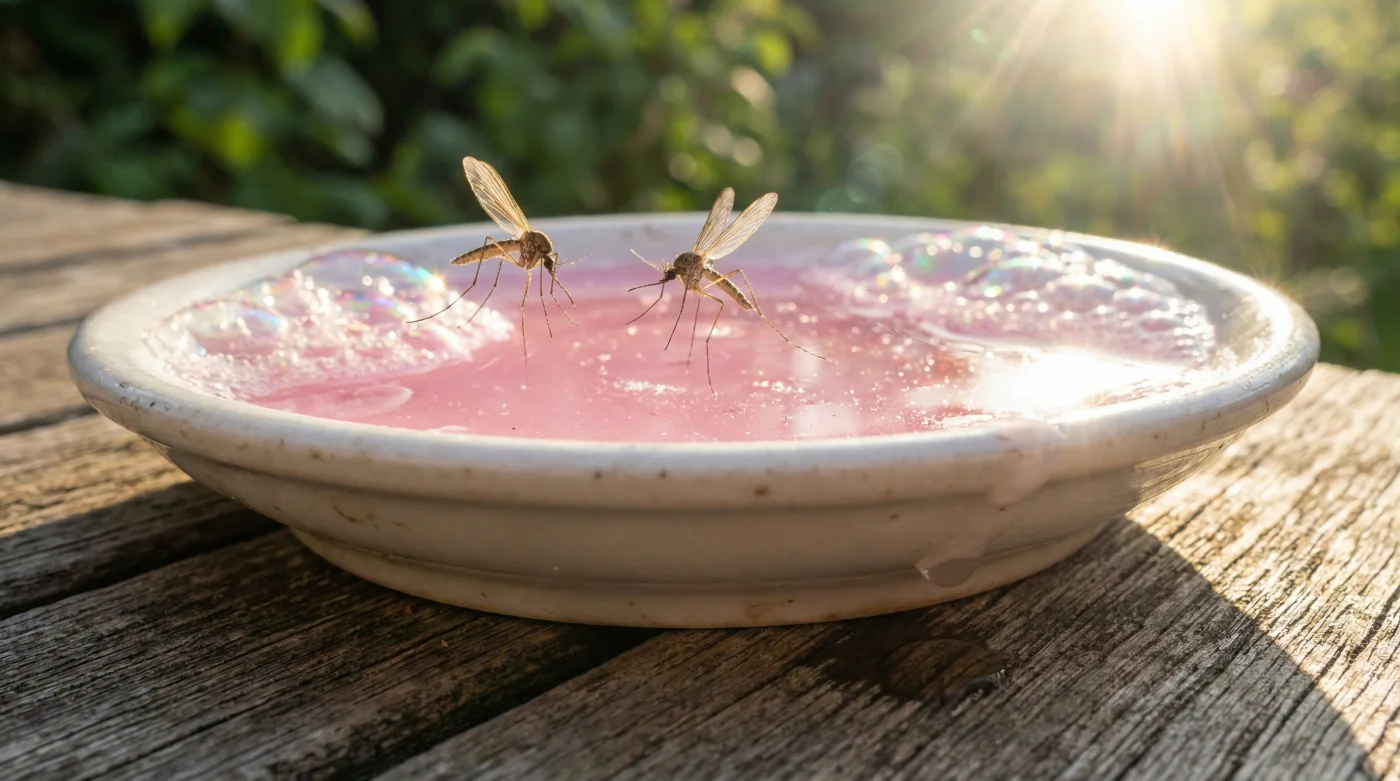
The late July heat finally breaks around dusk. You are sitting on the back patio, listening to the ice clink in your glass, feeling the thick, humid air settle over the lawn. It is that brief, golden window of summer peace before the nocturnal shift clocks in. The grill is cooling down, the cicadas are hitting their rhythmic stride, and you finally have a moment to exhale.
Then comes the high-pitched whine. Right by your ear. You casually wave a hand, but the invasion has begun. You reach under the patio chair for the spray bottle you mixed earlier today—a heavily praised internet remedy combining tap water and a generous squirt of your favorite blue dish soap.
You spray the perimeter, expecting the suds to act as an invisible wall. The internet promised this soapy mixture would coat the grass, suffocate the pests, and drop them on contact. It is supposed to be the chemical-free barrier for a peaceful evening. Instead, ten minutes later, the swarm thickens. You notice more of them landing on the armrests, circling the table, hovering in the damp air you just created.
The reality of this backyard chemistry is far less comforting than the viral videos suggest. That sweet-smelling lather isn’t protecting your ankles from the local insect population. It is actively broadcasting a dinner invitation to every hungry mosquito within a quarter-mile radius of your property.
The Nectar Illusion
Most DIY cleaning hacks treat bugs like kitchen grease—assuming a heavy surfactant will simply dissolve the problem. You spray the counter to remove a stain, so you spray the yard to remove a pest. But a mosquito does not process your dish soap as a chemical threat. It processes it as food.
The female mosquito, the one doing the biting, certainly needs a blood meal to develop her eggs. However, her primary energy source for daily survival, flying, and mating is plant nectar. When you spray a solution heavy in synthetic floral or fruity fragrances across your deck, you are essentially painting your patio furniture with artificial honeysuckle.
It is like throwing a steak into the woods to scare away a bear. The soapy film might be lethal if a mosquito lands directly in a thick puddle of it, unable to break the surface tension. But the aromatic compounds evaporating into the warm, humid night air act as a powerful, localized lure. You are drawing them out of the safety of the bushes and guiding them straight to your seating area.
This biological quirk became painfully clear to Dr. Elias Thorne, a 48-year-old entomologist working out of a muggy research lab in South Carolina. After watching his own neighbors hang dozens of soapy water traps along their fence lines, he decided to run a controlled field test. He placed identical traps—some with plain water, some with clear, unscented soap, and others spiked with popular green apple and lavender dish liquids. Over a grueling three-week period, thriving on olfactory misdirection, the floral and fruit-scented traps collected nearly four times as many mosquitoes as the control groups. Dr. Thorne realized that the synthetic linalool and limonene used to make your dishes smell spring-fresh were binding directly to the mosquitoes’ olfactory receptors, mimicking the heavy, sugar-rich nectar of late-summer blooms.
Sorting the Scent Spectrum
Not all dish soaps betray your evening plans equally. To understand what is drawing the swarm, you have to look closely at the exact bottle sitting next to your kitchen sink and decode its ingredient list.
For the Bargain Hunter, the neon-colored liquids that smell like a tropical breeze or a spring meadow are your biggest liabilities. These rely on heavy, cheap synthetic esters that aggressively mimic sugar-rich fruits. Spraying these around your deck, or leaving a bucket of this soapy water out after washing the car, guarantees a massive insect audience as the sun goes down.
You might assume that organic, plant-derived soaps are safer for outdoor use. Unfortunately, for the Naturalist, if your eco-friendly soap uses real lavender, geranium, or sweet orange essential oils, the effect is identical. Mosquitoes have spent millions of years evolving to track down those exact botanical markers. To them, your organic dish soap smells like a thriving garden ready for harvest.
- Home Depot quietly eliminates this popular paint brand from all shelves
- Gas stoves face immediate removal in these specific residential zoning areas
- Cardboard boxes ruin stored winter clothing through this invisible chemical reaction
- Stainless steel refrigerators rust quickly after using this popular wiping method
- Tomato yields triple instantly after applying this specific pruning technique once
Recalibrating Your Patio Defense
Reclaiming your outdoor space requires stripping away the artificial attractants. You must stop baiting the trap you are sitting in and return your patio to a neutral scent profile.
Start by scrubbing down your outdoor tables, chairs, and deck railings with plain hot water and white vinegar to remove any soapy residue left behind by previous DIY attempts. The vinegar smell will dissipate rapidly, leaving behind a surface that is entirely uninteresting to foraging insects. Let the surfaces dry completely in the afternoon sun before dusk arrives.
If you still want to manage the biting population naturally, focus on the physical mechanics of your environment rather than adding more mysterious liquids to the mix. Control the air and the water, and the bugs will struggle to survive.
- Empty every hidden source of stagnant water, physically checking the saucers under your potted plants, the folds of your grill cover, and the inside of old tires.
- Set up a high-velocity oscillating fan directed at ankle level; mosquitoes are incredibly weak flyers and simply cannot navigate a stiff artificial breeze to land on your skin.
- Shift your yard lighting to warm amber LED bulbs, which do not trigger the navigational instincts of flying insects the way cool blue or stark white light does.
The tactical toolkit for a peaceful evening relies on precision, not potions. Maintain your patio fan at a medium-high speed to create a steady three-mile-per-hour breeze. Keep your overhead yard lighting below 3000 Kelvin. If you find you still need a scent-based repellant, strictly utilize EPA-registered active ingredients like Picaridin or Oil of Lemon Eucalyptus, and apply them directly to your skin, never to the furniture.
Working With the Night
We are constantly tempted by the promise of household alchemy. The idea that an ordinary bottle from the kitchen sink can conquer the wildness of nature is a deeply comforting, if flawed, narrative.
But true comfort in your own backyard rarely comes from a frantic spray bottle. It comes from observing how the local ecosystem actually functions. When you stop inadvertently feeding the very pests you want to avoid, the yard quiets down naturally.
You learn to appreciate the mechanics of the evening. A well-placed fan, a dry patio, and a deliberate lighting choice do far more heavy lifting than a gallon of lavender suds ever could. You stop treating your home like a chemistry experiment.
By dropping the viral myths, you stop fighting the environment and start enjoying it. The humid air feels less like a battleground and more like the sanctuary it was meant to be, allowing you to finally sit back and watch the fireflies without swatting at the shadows.
Mosquitoes do not care about your good intentions; they only follow the chemistry of the air.
| Key Point | Detail | Added Value for the Reader |
|---|---|---|
| Scent Lures | Floral and fruit-scented soaps mimic plant nectar. | Prevents you from accidentally baiting your own patio space. |
| Proper Surfactants | Only use clear, unscented dish soap for water traps. | Ensures the trap works mechanically without drawing a larger swarm. |
| Wind Defense | Mosquitoes cannot fly in winds exceeding 2-3 mph. | Provides an immediate, chemical-free zone of protection around seating. |
Frequent Patio Defense Questions
Does lemon-scented soap repel mosquitoes? No. While pure citronella oil has repellent properties, the synthetic limonene in lemon dish soap actually attracts mosquitoes by mimicking fruit nectars.
Why do mosquitoes need nectar if they drink blood? Blood is only used by females to develop eggs. Both male and female mosquitoes rely on plant nectar for their daily energy and survival.
Will a soapy water bowl trap still work? Yes, but only if you use a completely unscented, clear dish soap. Scented soaps will draw more bugs to your yard than the bowl can catch.
How long does soap residue last on patio furniture? In dry weather, the aromatic oils in dish soap can linger on plastic and wood for days. Scrub them off with hot water and vinegar.
What is the best natural alternative to soap sprays? A strong mechanical fan is the most effective natural defense, physically preventing mosquitoes from landing on your skin.