The first freeze of November always brings that unmistakable scent, a faint, dry toast aroma as the furnace wakes up from its summer sleep and dust burns off the heat exchanger. You walk down to the basement, cardboard sleeve in hand, ready to perform the seasonal ritual. The concrete is cold beneath your shoes, and the ductwork overhead ticks slightly as the metal expands. This is the moment you prepare your home for the brutal months ahead, trusting that a fresh layer of filtration will keep the indoor atmosphere pristine.
You slide the stiff, pristine white rectangle into the metal track, shut the access panel, and walk away feeling responsible. But that simple, seemingly harmless sliding motion might be quietly suffocating your blower motor. Most homeowners treat this task like dropping a letter into a mailbox, assuming that as long as the object fits inside the slot, the system will seamlessly take care of the rest without any negative consequences.
The assumption is that buying the highest-rated pleated square at the hardware store guarantees clean air and a healthy machine. We stand in the brightly lit aisles of the home improvement center, carefully reading the microscopic particle ratings on the plastic wrappers, convinced that spending more money automatically translates to superior protection. We treat the slot like a passive receptacle, completely ignoring the volatile physics happening just behind the thin sheet metal panel.
In reality, your furnace operates like a lung, requiring precise, unobstructed airflow to keep the metal from overheating. By treating the installation as a simple drop-in chore, you create microscopic choke points that force the fan to work twice as hard. The blower motor is designed to pull a very specific volume of air per minute, and when that calculation is thrown off by poor seating, the internal temperature of the equipment rises dangerously close to the failure point.
The Anatomy of Inhalation
Your forced-air system operates on a delicate balance of atmospheric pressure. When you cram a highly restrictive particulate trap into the return drop without understanding the directional pull of the blower, you are essentially asking your home to breathe through a thick down pillow. The fan has to physically drag oxygen through those dense synthetic fibers, and every millimeter of resistance adds electrical strain to the copper windings inside the motor housing.
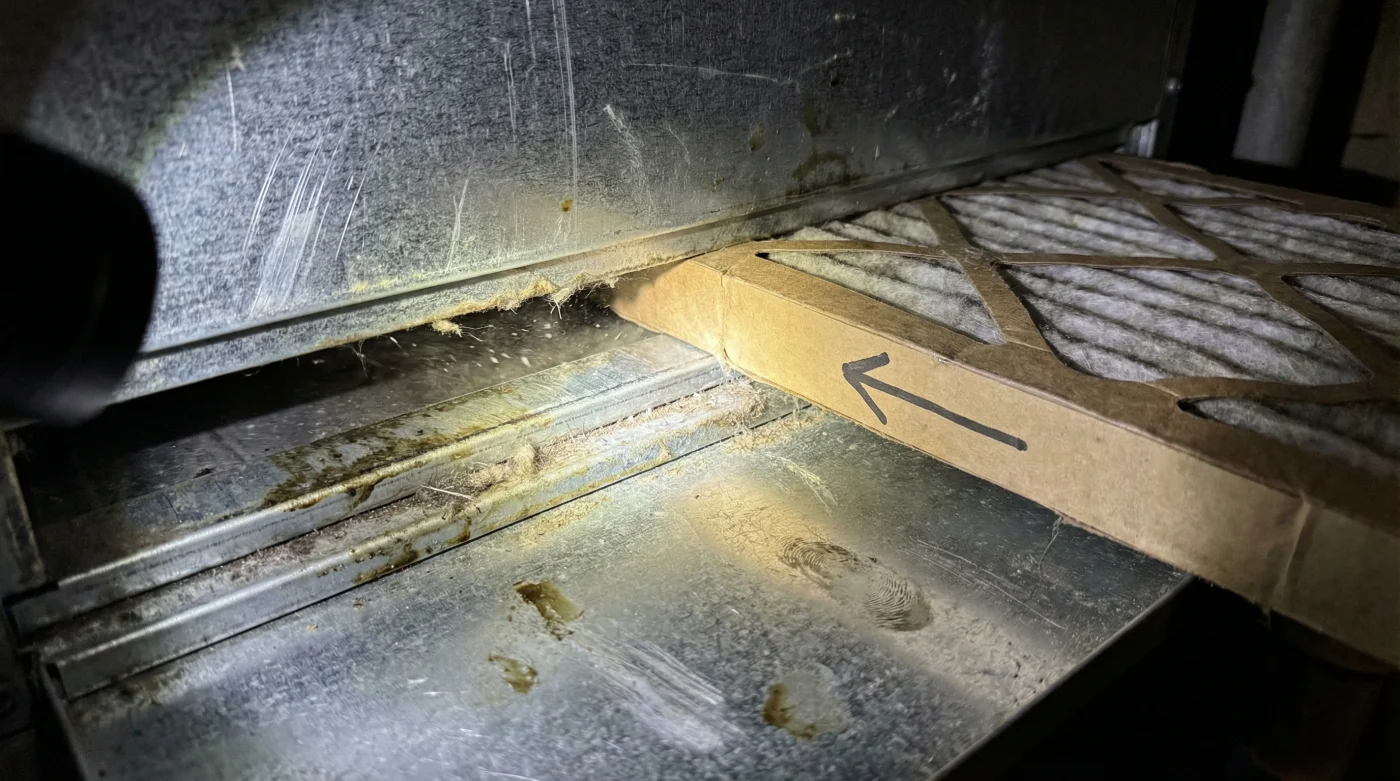
The cardboard edge is not just a structural frame; it acts as a vital gasket. If you miss the tiny, printed arrow indicating airflow direction, the fan strains against the resistance, dragging dust past the gaps and burning out the bearings. The wire mesh backing on one side of the pleats is engineered specifically to prevent the media from collapsing inward under the immense vacuum force generated by the spinning squirrel cage.
Marcus, a 58-year-old HVAC technician who spends his Detroit winters entirely in cramped crawlspaces, keeps a sobering collection of melted blower motors on a shelf in his shop. He leans against his dented work truck and explains the phenomenon with quiet frustration. People buy hospital-grade squares, he notes, shove them in backward, and leave a quarter-inch gap on the side because they assume close enough is perfectly fine. The motor tries to pull air, hits a wall of unsupported cardboard, and slowly overheats over the course of a single winter. It is an incredibly expensive failure caused by a ten-second oversight.
It is a harsh mechanical truth. If air can find a path around the primary barrier, it will take the destructive shortcut, carrying coarse pet hair and microscopic skin cells straight into the delicate electrical housing. Once that debris bypasses the intended catch zone, it coats the damp evaporator coils and bakes onto the heat exchanger, severely reducing the lifespan of the entire heating and cooling ecosystem.
Tailoring the Fit for Your Space
Not all air returns are created equal, and very few of them are perfectly square. The sheet metal ducts in your home shift, warp, and sag over decades of expanding during the heating season and contracting during the summer cooling cycle. The slot that was measured precisely by a fabricator thirty years ago is now slightly bowed in the middle, leaving gaping vulnerabilities along the top and bottom tracks.
Depending on your specific living situation, the demands on your blower change dramatically. Recognizing the unique quirks of your ductwork and the particular contaminants inside your living space allows you to modify the basic installation process. You can stop treating the replacement cycle as a one-size-fits-all chore and start addressing the actual physical realities of your basement setup.
- Home Depot quietly eliminates this popular paint brand from all shelves
- Gas stoves face immediate removal in these specific residential zoning areas
- Cardboard boxes ruin stored winter clothing through this invisible chemical reaction
- Stainless steel refrigerators rust quickly after using this popular wiping method
- Tomato yields triple instantly after applying this specific pruning technique once
For the Vintage Home Dweller, metal slots are rarely plumb and almost never perfectly sealed. Decades of structural settling mean those tracks are bent or widened beyond their original specifications. These old spaces require a physical buffer to prevent air from rushing around the cardboard edges, making the weatherstripping modification an absolute necessity rather than a simple optional upgrade.
For the Allergy Purist, using ultra-restrictive weaves means the system is already working significantly harder than it normally would to pull oxygen through the dense material. Perfect alignment of the directional arrow and absolute airtight edges are non-negotiable to maintain system longevity. If you demand the highest level of particulate capture, you must compensate by ensuring zero air escapes around the perimeter.
The Five-Minute Preservation Protocol
Protecting your expensive heating equipment requires a fundamental shift in how you handle that cardboard square. You must shift your tactile attention away from merely closing the door to actually sealing the chamber. It is about feeling the resistance of the materials and confirming that the gap is completely closed before you walk back up the stairs.
- Identify the Flow: Locate the printed arrow on the cardboard spine. This arrow must point strictly toward the furnace, following the exact direction the air is being pulled from the house into the machine.
- The Foam Seal Hack: Purchase a roll of quarter-inch closed-cell weatherstripping tape from the hardware store. Apply a single continuous strip along the top and bottom edges of the cardboard frame.
- The Friction Fit: Slide the modified square into the metal track. You should feel a slight, satisfying resistance as the foam compresses against the metal casing, firmly closing the bypass gap.
- Date and Monitor: Write the installation date on the spine with a dark marker. Check the foam compression after thirty days to ensure the seal remains tight and the media is not bowing under pressure.
This method creates a true mechanical gasket. The air is forced directly through the synthetic media rather than whistling around the sides, ensuring that every cubic foot of oxygen entering your home has been properly scrubbed.
Before the thermostat drops another degree and the deep freeze sets in, gather the basic and cheap provisions: a fresh insert, a small flashlight to inspect the track, and a roll of weatherstripping. Taking five minutes to prepare the materials will save you the anxiety of an emergency service call in the middle of a blizzard.
The Quiet Rhythm of a Healthy House
Paying attention to how air enters your heating system fundamentally changes your relationship with the house. It moves your mindset from a passive resident hoping things do not break, to a place of active stewardship where you are intentionally preserving the mechanical heartbeat of your environment. You stop worrying about invisible dust and start trusting the physical seal you created with your own hands.
When the motor hums to life on a zero-degree January night, you hear smooth and effortless warmth instead of a struggling, whining machine. You can sleep soundly knowing that the air circulating through your vents is genuinely clean, and the equipment working tirelessly in the dark basement is protected against premature failure.
A furnace is only as healthy as the air it breathes; secure the perimeter and the motor will outlive you.
| Key Point | Detail | Added Value for the Reader |
|---|---|---|
| Arrow Direction | Points strictly toward the blower motor. | Prevents severe electrical strain and structural failure of the material. |
| Foam Seal Hack | Weatherstripping tape on the cardboard edge. | Stops dust from bypassing the media and entering the mechanical housing. |
| Friction Fit | Slight resistance when sliding into the track. | Ensures a perfectly airtight seal for maximum indoor air purity. |
Frequently Asked Questions
Why does the arrow direction matter so much? The pleats are reinforced with wire on one side to prevent them from collapsing under the immense vacuum force of the blower.
What kind of weatherstripping should I use? A quarter-inch closed-cell foam tape works best because it compresses easily against the metal without crumbling over time.
Can I use duct tape instead of foam? Tape makes the removal process messy and often leaves a sticky residue on the metal track. Foam provides a clean, repeatable seal.
How often should I reapply the foam? Reapply the foam hack every time you swap the square, which should be every thirty to ninety days depending on your household environment.
Will this tight seal restrict airflow too much? No, it correctly forces the air through the material exactly as the manufacturer designed, rather than allowing it to take the path of least resistance around the sides.